Case file · Ghost light · Road, bridge or woods
Brown Mountain Lights
Also known as The Brown Mountain Light, Lights of Linville Gorge
Glowing orbs said to rise above a low Blue Ridge ridge since at least 1913 – studied by the USGS, set to music and still drawing night-time watchers.
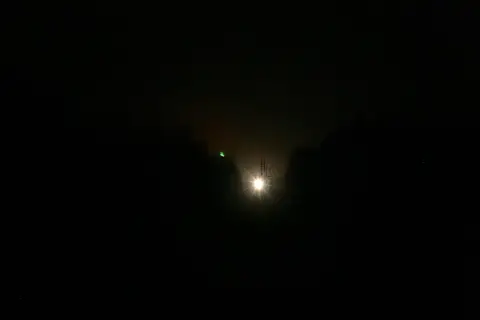
Brown Mountain is an unremarkable, flat-topped ridge in the Pisgah National Forest, on the edge of Burke County in North Carolina’s Blue Ridge foothills, overlooking Linville Gorge and the Catawba valley. Its fame rests entirely on its lights: reports of red, white or orange balls that appear above the ridge at night, hover or drift, flare, and vanish.
The first published account came in a Charlotte Daily Observer article of September 24, 1913, which described red lights appearing punctually at set times each evening. That same year a U.S. Geological Survey geologist concluded that the observers were seeing the headlights of locomotives on the Southern Railway. Locals objected that the lights kept appearing when floods stopped the trains in 1916, so in 1922 USGS geologist George Rogers Mansfield spent two weeks in the area with surveying instruments. He attributed nearly half the sightings to automobile headlights, a third to locomotives, and the rest to stationary lights and brush fires, all seen across the deep valley through layers of air that can make distant lights shimmer, change colour and seem to float.
Legend has grown around the science. Stories date sightings back to the 18th century – an often-quoted 1771 account by surveyor William de Brahm turns out to describe something else – or tell of a ghostly slave searching with a lantern for his lost master, a tale with close parallels in other states. A claim that the Cherokee saw the lights as the spirits of widows searching for husbands killed in battle first appeared, without a source, in a 1938 newspaper; historians regard it as an invented “Indian legend” rather than a Cherokee tradition. Scotty Wiseman’s 1961 song “The Legend of the Brown Mountain Lights,” recorded by the Kingston Trio and others, carried the story nationwide.
Investigations have kept coming. In 1977 scientists from Oak Ridge National Laboratory shone a powerful arc light from a distant valley and produced an orange-red glow that appeared to hover over the ridge. Appalachian State University later trained low-light cameras on the mountain and, by 2014, had recorded thousands of hours without capturing an unexplained light. Skeptics such as Joe Nickell conclude that there is no single phenomenon to explain – just many ordinary lights seen in a landscape that plays tricks on the eye.
What people report
Glowing orbs, usually red, orange or white, that rise above or along the ridge, hover, pulse, split or drift and then disappear; more recently, flickering lights moving on the slopes of Linville Gorge – reported by local residents, tourists and amateur investigators.
Where and when
Seen looking toward Brown Mountain from the Brown Mountain Overlook on NC 181, the Lost Cove and Green Mountain overlooks on the Blue Ridge Parkway, and Wiseman’s View above Linville Gorge, usually on clear autumn nights after dark.
Timeline of the haunting
- September 24, 1913First newspaper report Burke County, North Carolina
The Charlotte Daily Observer described red lights rising over Brown Mountain at regular times each night. A USGS geologist soon linked them to train headlights.
- 1922The Mansfield survey Burke County, North Carolina
USGS geologist George Rogers Mansfield spent two weeks mapping sightings and attributed them to vehicle and train headlights, fixed lights and brush fires, magnified by atmospheric effects.
- 1961The song North Carolina
Scotty Wiseman’s “The Legend of the Brown Mountain Lights” became a folk and bluegrass standard and made the lights famous far beyond the Blue Ridge.
- 1977Oak Ridge light experiment Burke County, North Carolina
Scientists projected a distant arc light that observers saw as an orange-red orb hovering over the ridge, supporting the refraction explanation.
- 2014Cameras on the mountain Linville Gorge, North Carolina
Appalachian State University’s low-light cameras had logged some 6,300 viewing hours with no unexplained lights recorded.
What could explain it?
- Distant headlights of trains and cars, refracted by temperature layers in the valley air, account for most traditional sightings, according to USGS studies.
- Brush fires, campfires, town lights, radio-tower beacons and aircraft explain others.
- Hikers’ headlamps and flashlights in Linville Gorge are the likely source of modern “hillside” lights.
- The supposed ancient Cherokee legend and 18th-century sightings are not supported by the historical record.
- Looking for lights in darkness causes the eye to see stationary points as moving (the autokinetic effect).
Ghost tours, books and screen
The lights inspired Scotty Wiseman’s 1961 song and “Field Trip,” a 1999 episode of The X-Files set around Brown Mountain, appear in countless books on Appalachian mysteries, and remain a point of local pride in Burke County.
Places to visit
A roadside overlook in the Pisgah National Forest facing Brown Mountain; stay on public land and roadsides after dark.
Watch
 4:48
4:48
My Home, NC | Mystery of the Brown Mountain Lights
 17:10
17:10
The mystery of the Brown Mountain lights
Where it’s reported
Brown Mountain Lights in the news
No recent headlines about Brown Mountain Lights. Our news desk checks every day — see all the latest paranormal news.
Sources
First published · Updated