Case file · Residual haunting · Prison or jail
Eastern State Penitentiary
Also known as ESP, Cherry Hill, State Correctional Institution at Philadelphia
Philadelphia’s Gothic prison pioneered solitary confinement in 1829. Staff, guards and visitors tell of faces, footsteps and whispers in its cellblocks.
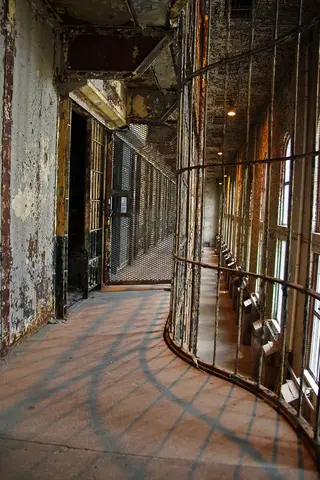
When Eastern State Penitentiary admitted its first prisoner in October 1829, it was the most expensive public building in the young United States and the purest test of a radical idea. Architect John Haviland laid out seven cellblocks radiating like spokes from a central hub, and the “Pennsylvania system” kept each prisoner alone in a vaulted, skylit cell to work, read the Bible and – in theory – become penitent. Hoods were placed over inmates’ heads whenever they were moved so that no one would recognise anyone else.
The experiment drew admirers and critics from around the world. Alexis de Tocqueville came to study it; Charles Dickens visited in 1842 and condemned its “rigid, strict and hopeless solitary confinement.” Overcrowding wore the system down – a prison built for a few hundred held about 1,700 men by the mid-1920s – and solitary confinement was formally abandoned in 1913. The complex grew to fifteen cellblocks, including a Death Row block added in 1956, though no executions took place on site.
Its inmate roll includes the bank robber Willie Sutton, who was among twelve men who escaped through a tunnel in April 1945, and Al Capone, held here for about nine months in 1929–30 on a concealed-weapon charge. Pennsylvania closed the prison in 1970; after a brief stint as a city jail it stood empty, roofs collapsing and trees growing through the cells, until a preservation campaign stopped a sale in 1988. Hard-hat history tours began in 1994.
By then, Eastern State already had a reputation. NPR, reporting in 2013, noted that stories from guards, inmates, staff and visitors had echoed one another since the 1940s. The best known comes from Gary Johnson, a locksmith who helps maintain the old locks: he has said that in the early 1990s, after opening a cell in Cellblock 4, a force gripped him so hard he could not move, and anguished faces seemed to form on the walls. Capone himself is said to have complained of being haunted in his cell by “Jimmy” – usually identified as James Clark, a victim of the St. Valentine’s Day Massacre – a tale repeated by tour guides and ghost books but impossible to verify.
The museum itself takes a careful line. Its staff stress that some 70,000 people passed through the prison and that their lives, not their ghosts, are the story; a guide told NPR that Eastern State does not claim to be haunted but runs a haunted attraction. That attraction – the Halloween fundraiser first held in 1991, later called Terror Behind the Walls and now Halloween Nights – has done as much as any television crew to fix the building’s image as one of America’s most haunted places.
What people report
Reports include ghostly faces on cell walls, shadowy figures moving along corridors, echoing voices, cackling laughter, wailing and whispering, footsteps in empty blocks, and the silhouette of a guard watching from a tower. Paranormal TV teams have recorded what they describe as voices and unexplained noises.
Where and when
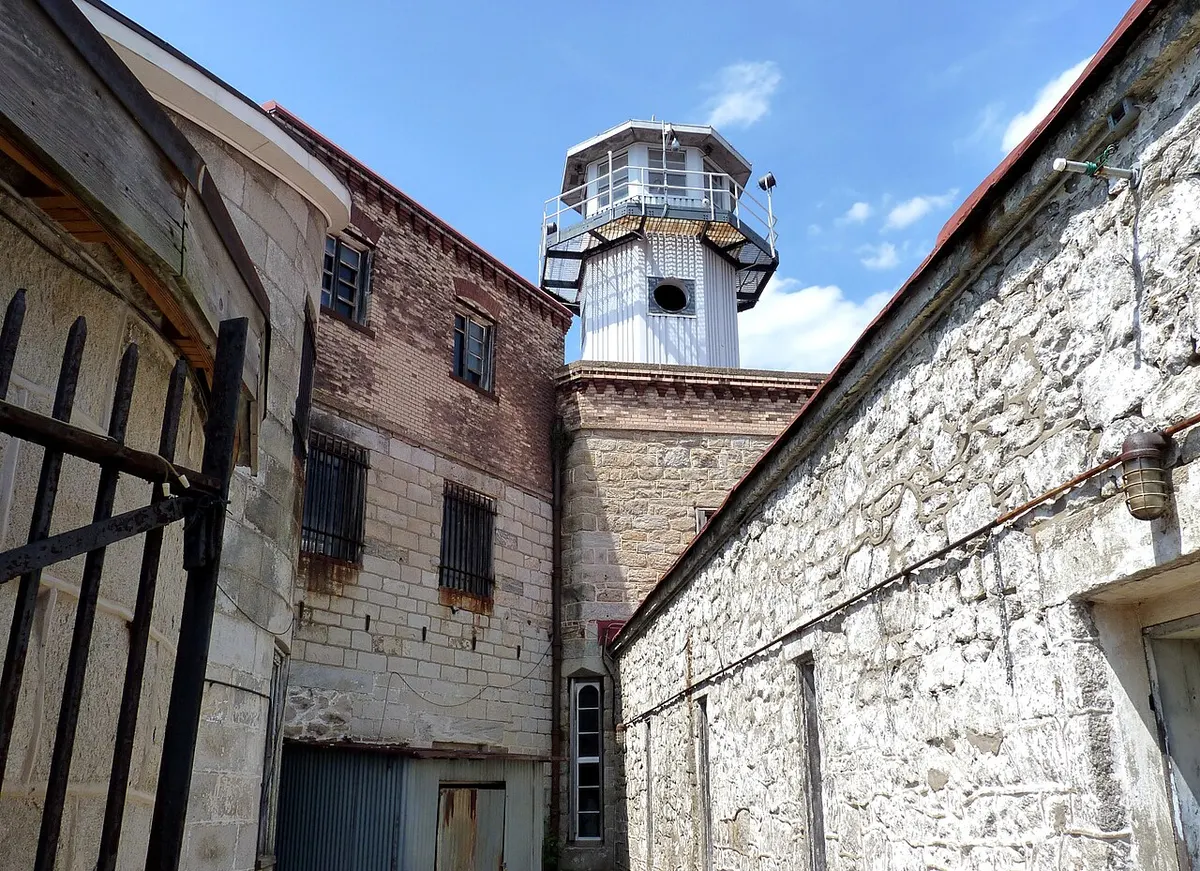
Cellblock 4 is linked to visions of faces, Cellblock 6 to darting shadow figures and Cellblock 12 to echoing voices and laughter. A guard figure is reported in one of the perimeter towers, and Capone’s reconstructed cell on “Park Avenue” attracts its own stories. Most accounts come after dark, during investigations and the autumn Halloween season.
Timeline of the haunting
- October 1829The penitentiary opens Philadelphia, Pennsylvania
Eastern State receives its first prisoner and begins its long experiment in separate confinement. The radial plan and isolated cells become a model for hundreds of prisons worldwide.
- 1929–1930Al Capone’s stay Philadelphia, Pennsylvania
Al Capone serves about nine months on a weapons charge, leaving in March 1930. Later ghost lore claims he was tormented in his cell by the spirit of a gangland victim, a story with no contemporary record behind it.
- Early 1990sThe locksmith’s encounter in Cellblock 4 Philadelphia, Pennsylvania
Locksmith Gary Johnson says that after opening an old cell lock he was held fast by an unseen force and saw tormented faces on the walls. It remains the prison’s most retold ghost account.
- June 2007Most Haunted Live broadcasts overnight Philadelphia, Pennsylvania
The British series Most Haunted Live spends seven hours investigating the prison on air. It joins Ghost Hunters, Ghost Adventures and MTV’s Fear among the programmes filmed here.
- October 2013NPR asks whether it is really haunted Philadelphia, Pennsylvania
An NPR feature collects the prison’s recurring ghost stories, while a tour guide explains that the museum does not claim the building is haunted and stresses that the inmates were real people.
What could explain it?
- Expectation and setting: visitors arrive primed by TV shows and the Halloween attraction, and a dark, decaying prison readily turns ambiguous sensations into “presences.”
- The vaulted stone corridors carry and distort sound, so voices, footsteps and street noise from outside the walls can seem to come from empty cells.
- Pareidolia: peeling paint, water stains and shadows on cell walls lend themselves to being seen as faces.
- Many of the most famous stories, including Capone’s haunting, come from retellings decades after the fact rather than from contemporary records.
- Ghost lore is part of the site’s marketing through its Halloween fundraiser, which shapes how visitors interpret what they experience.
Ghost tours, books and screen
Eastern State has been featured on Ghost Hunters, Ghost Adventures, Most Haunted Live (2007), MTV’s Fear and BuzzFeed Unsolved. Its Halloween event, begun in 1991 and long known as Terror Behind the Walls, became one of the country’s largest haunted attractions; the museum now pairs it with history tours, art installations and exhibits on mass incarceration.
Places to visit
Museum with audio and guided tours year-round and the Halloween Nights event each autumn.
Watch
 31:45
31:45
Haunting Histories at Eastern State Penitentiary, Part 1
 8:47
8:47
Eastern State Penitentiary in 1929
Where it’s reported
Field reports
Eastern State Penitentiary in the news
Sources
First published · Updated