Case file · Apparition · Hotel or inn
The Marshall House
Also known as Marshall House Hotel, Savannah’s oldest hotel
Savannah’s 1851 hotel doubled as a yellow fever and Union hospital, and guests since its 1999 restoration report children, soldiers and running taps.
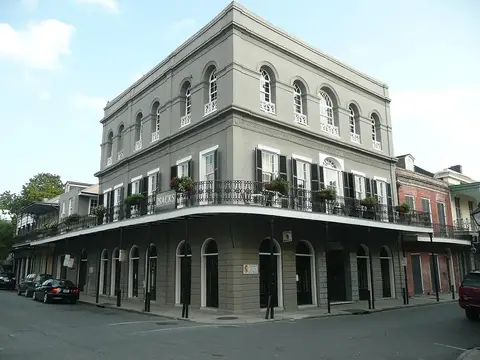
The Marshall House opened in 1851 on Broughton Street, in the heart of Savannah’s shopping district, built by Mary Marshall as a purpose-built hotel. A cast-iron veranda was added in 1857 and the building was renovated in 1859. During the nineteenth century it was pressed into service as a hospital: the hotel’s own history says it was used during yellow fever epidemics and that Union troops under General William Tecumseh Sherman occupied it in 1864–65, turning it into a hospital for wounded soldiers until the war ended. Joel Chandler Harris, creator of the Uncle Remus stories, is also said to have lived there after the war.
The hotel closed in 1895 and reopened in 1899, adding electric light and baths on every floor, and later passed through a series of owners and names. It closed for good, as it then seemed, in 1957, when meeting fire codes on a short lease proved impractical. Its upper floors were abandoned for decades while shops kept the ground floor until 1998. That year renovation began, and in 1999 the restored hotel reopened as Savannah’s oldest.
Most of the ghost stories date from that restoration. Tour companies say workers pulling up floorboards on the ground floor in the late 1990s found human remains, and that the room was treated as a crime scene until it was understood to have been a hospital surgery; historians, they say, believe the bones were amputated limbs from Civil War soldiers. The hotel’s own history pages do not mention the discovery and the date and the number of bones vary from telling to telling, so it is best treated as lore until documented. What guests report, though, is consistent with the building’s past: children heard laughing and running in the halls at night, faucets turning themselves on, rotting smells in a few rooms, and figures in period dress.
The stories are well known. Savannah ghost tours from several companies stop at the hotel, and the Travel Channel listed it in its Haunted Hotels programming in 2005. Named spirits include a woman said to resemble the portrait of Mary Marshall, a writer whose typewriter is heard from Harris’s former room, and a soldier associated with Room 314. The stories remain anecdotal, undated and mostly anonymous, which is typical of hotel ghosts.
What people report
Guests describe children laughing or running in hallways around 3 a.m., faucets and lights turning on, odd voices through the walls, smells of rot in rooms 214, 314 and 414, figures of amputee soldiers, a woman in white and a presence gripping a wrist as if taking a pulse.
Where and when
Guest-room floors, especially rooms 214, 314 and 414, the corridors, the fourth floor in the early morning and the former operating room on the ground floor.
Timeline of the haunting
- 1851The hotel opens Savannah, Georgia
Mary Marshall opened the hotel on Broughton Street. It later served as a hospital during yellow fever epidemics.
- 1864–1865Union occupation and hospital Savannah, Georgia
Union troops under General Sherman occupied the building and used it as a hospital for wounded soldiers until the war ended.
- 1957The hotel closes Savannah, Georgia
Unable to meet fire codes on a short lease, the owners closed the hotel. Its upper floors stood empty for four decades.
- 1999Restoration and reopening Savannah, Georgia
After the 1998 renovation the hotel reopened. Tour companies say human remains found during the work are the source of the ghost stories.
What could explain it?
- Undocumented origin: the story of bones under the floor appears in tour material, but the hotel’s own history does not mention it and dates and details vary.
- Ordinary building sounds: an old brick hotel with a courtyard, pipes and creaking floors gives rise to running taps, door rattles and “footsteps”, and guests in unfamiliar beds are primed by the hotel’s reputation.
- Anonymous accounts: the reports come from guests and tour operators with a commercial interest, and few are dated or named.
- Real history, shaped by retelling: the hotel really was a hospital, but the details of ghosts (marbles, bite marks, wrist pulses) fit a template that hotel ghost stories share.
Ghost tours, books and screen
The hotel appears in Savannah ghost tours from several operators and was listed by the Travel Channel among its haunted hotels in 2005. Artifacts found in the restoration are displayed on the second and third floors.
Places to visit
A working boutique hotel on Broughton Street, with historic displays and frequent ghost-tour stops.
Where it’s reported
Sources
First published · Updated