Case file · Apparition · House or mansion
Myrtles Plantation
Also known as The Myrtles, Laurel Grove
Billed as America’s most haunted house, this plantation is famous for “Chloe,” an enslaved woman the records show never lived there. One murder is real.
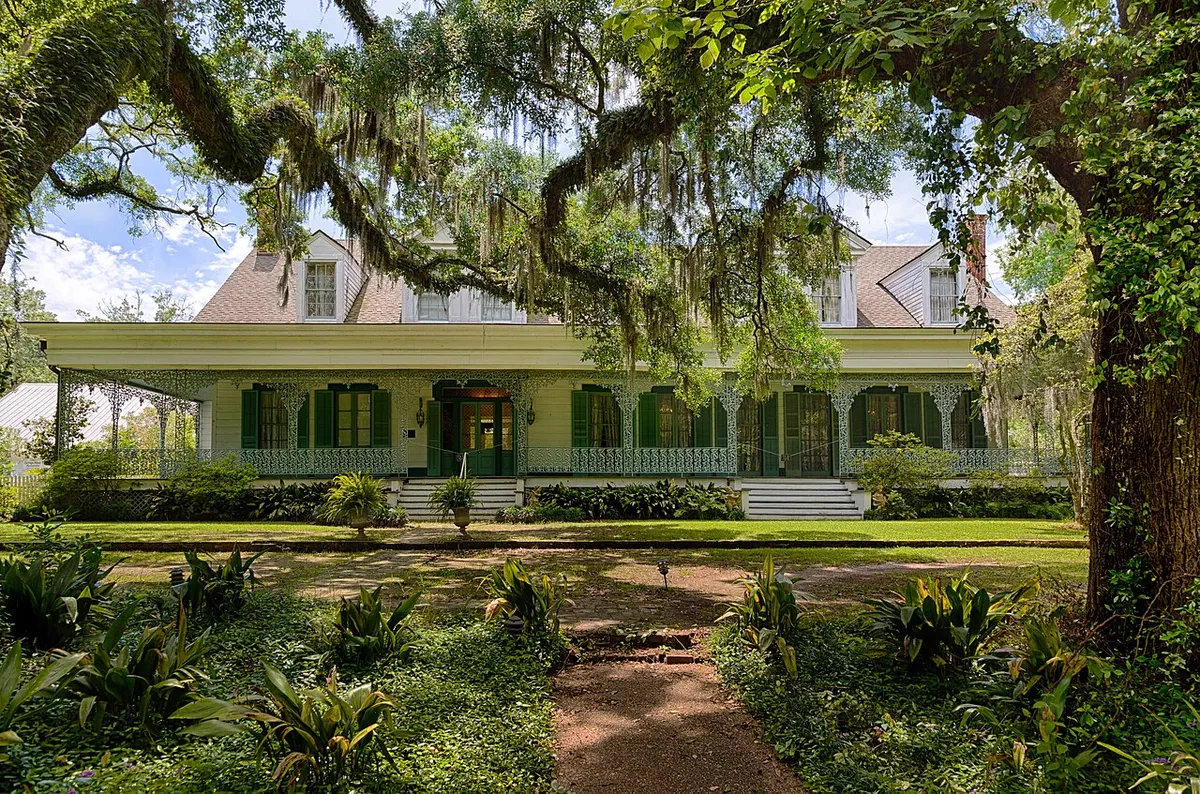
The Myrtles stands among live oaks outside St. Francisville, in the cotton country of West Feliciana Parish. David Bradford, a leader of Pennsylvania’s Whiskey Rebellion who fled south, built the original house, which he called Laurel Grove, in 1796. In 1817 his daughter Sara Mathilda married Clark Woodruff, a lawyer, who took over the plantation. In 1834 it passed to Ruffin Gray Stirling, who bought the property together with the people enslaved on it, renamed it the Myrtles and in the 1850s nearly doubled the house into the long-galleried mansion seen today. Its wealth, like that of every plantation along this stretch of the Mississippi, was produced by enslaved men, women and children whose names are largely absent from the stories now told there.
The house’s famous ghost story concerns “Chloe,” described as an enslaved woman forced into a sexual relationship with Clark Woodruff, punished by having an ear cut off for eavesdropping, who then poisoned a birthday cake with oleander, killing Sara Woodruff and two of her daughters, and was hanged by the other enslaved workers. Visitors are told that she wanders the house in a green turban to hide her wound, and the plantation sells a 1992 photograph said to show her between two buildings. Some versions call her “Cleo.”
The historical record contradicts nearly every element. Researcher Troy Taylor, working from records in St. Francisville, found that the Woodruffs’ property records list the people they enslaved and that no one named Chloe or Cleo appears among them. Sara Woodruff died on 21 July 1823 and her children James and Cornelia in July and September 1824, of yellow fever – not poison; their sister Octavia lived to old age, and Clark Woodruff died peacefully in 1851. The legend itself can be traced: a nameless older woman in a green bonnet in a Williams family story; a ghost narrative promoted by owner Marjorie Munson in the 1950s; and the ear, the cake and the poison added in the 1970s, spread nationally by LIFE magazine in 1980 and by later owners who ran the house as a bed and breakfast.
The Myrtles is often said to have seen ten murders. Only one is documented: William Drew Winter, Ruffin Stirling’s son-in-law, was shot on the front gallery by a man on horseback in January 1871 and died there; the case was never resolved. The tale that he staggered inside and died on the seventeenth stair is an embellishment, and claims of murdered Union soldiers, a stabbed Stirling son and a killed caretaker have no support in burial or court records. Historian Tiya Miles has argued that the Chloe and Cleo stories are fundamentally stories of violence against Black women, built on old stereotypes, and that they stand in for – and distract from – the real, unrecorded suffering of the people enslaved at the Myrtles. That is the history visitors deserve to hear.
What people report
Guests and staff report a woman in a green turban or headwrap, children seen on the gallery and in mirrors, handprints said to appear in a hall mirror, footsteps on the stairs, a piano playing by itself, the smell of tobacco, and a man staggering up the stairs. Visitors photograph the grounds hoping to repeat the famous 1992 “Chloe” image.
Where and when
The front gallery where William Winter was shot, the main staircase, the entrance-hall mirror, the gentlemen’s and ladies’ parlours and the guest rooms of the main house. Evening “mystery tours” focus on these spots.
Timeline of the haunting
- 1796David Bradford builds Laurel Grove St. Francisville, Louisiana
The Whiskey Rebellion leader builds the original house. His daughter Sara Mathilda marries Clark Woodruff in 1817.
- 21 July 1823Sara Woodruff dies of yellow fever St. Francisville, Louisiana
Sara Mathilda Woodruff dies in a yellow fever outbreak; her children James and Cornelia die of the disease in 1824. Later legend recasts their deaths as a poisoning.
- 26 January 1871William Winter is shot St. Francisville, Louisiana
Lured onto the front gallery by a rider, Winter is shot and killed – the one documented murder at the Myrtles. No one is convicted.
- November 1980LIFE spreads the poison-cake story St. Francisville, Louisiana
National press coverage popularises the Chloe legend, and the Myrtles is soon marketed as one of America’s most haunted houses.
- 1992The “Chloe” photograph St. Francisville, Louisiana
Owner Teeta Moss takes a photograph said to show a figure between two buildings; it becomes the plantation’s most famous image.
- 2002Unsolved Mysteries episode St. Francisville, Louisiana
The house appears on Unsolved Mysteries, followed by Ghost Hunters (2005), Ghost Adventures and other programmes.
What could explain it?
- Property records list the people the Woodruffs enslaved, and no Chloe or Cleo appears; the Woodruff deaths are recorded as yellow fever, so the central legend is a twentieth-century invention.
- The story grew in identifiable stages under successive owners who ran the house as a tourist business, with each version adding more violent detail.
- Of roughly ten claimed murders, only William Winter’s 1871 killing is supported by contemporary records.
- The famous photograph is a low-resolution image of shadows and foliage, a classic case of pareidolia.
- Old houses produce creaks, footsteps and drafts, and overnight guests in a “most haunted” house are primed to interpret them.
Ghost tours, books and screen
The Myrtles has appeared on Unsolved Mysteries, Ghost Hunters, Ghost Adventures and the 2024 series Files of the Unexplained, and has long been promoted as “America’s most haunted house” – the phrase former owner Frances Kermeen used in the subtitle of her book about it. Historian Tiya Miles analyses it in Tales from the Haunted South (2015) as a case study in how ghost tourism distorts the history of slavery.
Places to visit
A working bed and breakfast with guided tours of the downstairs rooms daily and evening mystery tours; ask guides about the documented history as well as the legends.
Watch

Where it’s reported
Field reports
Myrtles Plantation in the news
No recent headlines about Myrtles Plantation. Our news desk checks every day — see all the latest paranormal news.
Sources
First published · Updated