Case file · Phantom traveller · Road, bridge or woods
The Phantom Canoe of Lake Tarawera
Also known as Waka wairua of Tarawera, Tarawera spirit canoe
Days before Mount Tarawera erupted in 1886, a boat of tourists and Māori guides saw a war canoe on the lake that vanished – a waka wairua, said a tohunga.
In the 1880s the lakes south-east of Rotorua were New Zealand’s greatest tourist sight. Visitors from across the British Empire came to the village of Te Wairoa, home of the Tūhourangi people of Te Arawa, to be rowed across Lake Tarawera by Māori boatmen and guided to the Pink and White Terraces – vast staircases of silica on the shore of Lake Rotomahana. The trade brought money to Te Wairoa, but also drink, disease and tension; the village had suffered a run of deaths, some from typhoid, in the months before the eruption. Mount Tarawera itself, with its chiefly burial caves, was tapu.
On 31 May 1886 the guide Sophia Hinerangi took a party of tourists across the lake. They had already been unsettled at the landing, where the creek had drained, beaching the boats, then twice surged back in. Halfway across, under a clear sky, the party – Māori and Pākehā alike – saw a large canoe being paddled hard, under half a kilometre away. Witnesses described rows of paddlers wrapped in flax cloaks, heads bowed and hair dressed with feathers as for a funeral; in at least one telling of Sophia’s story they had the heads of dogs. Then it was gone. No such canoe was known on the lake.
Opinion divided over what it meant. The chief Rangiheuea read the signs as a war coming. Tūhoto Ariki, the aged tohunga of Te Wairoa, said it was a waka wairua – a spirit canoe – foretelling that the whole district would be overwhelmed. Some at the time linked his warning to his anger over what tourism was doing to Tūhourangi.
In the early hours of 10 June 1886 Mount Tarawera split open along a 17-kilometre rift. The eruption buried Te Wairoa and wiped out the villages of Moura and Te Ariki; about 120 people are now thought to have died, nearly all of them Māori. The terraces were destroyed. Tūhoto was dug out alive from his buried whare after four days, protesting that he should be left alone, and died at the Rotorua sanatorium weeks later. For many, his prophecy and the canoe on the lake became part of how the disaster was remembered.
The waka wairua belongs to Māori tradition, in which signs and omens before death and disaster are taken seriously, and the story is told today with that weight – it is part of the history of Tūhourangi, whose descendants still guide visitors at the excavated village. It is not a haunting in the European sense, and it is best understood as a remembered omen rather than a ghost to be hunted.
What people report
A single, well-witnessed sighting: a large waka seen at a distance on a calm morning, with paddlers and standing figures in flax cloaks and mourning feathers, which drew closer, seemed to change size and then disappeared. Later versions add dog-headed paddlers and a canoe that sank into the lake.
Where and when
On Lake Tarawera, between the landing near Te Wairoa and Te Ariki on the far shore, in late May 1886. The site of Te Wairoa is now the Buried Village museum.
Timeline of the haunting
- May 1886The creek runs dry Te Wairoa, Lake Tarawera
On one of Sophia Hinerangi’s trips, her party finds Wairoa Creek drained, then refilled by surges of water – a series of seiches in the lake as the ground beneath it stirred.
- 31 May 1886The canoe on the lake Lake Tarawera
Tourists and Māori guides see a war canoe that vanishes. Tūhoto Ariki declares it a waka wairua heralding destruction.
- June 1886Tūhoto is found alive Te Wairoa
Rescuers dig the tohunga out of his buried whare after four days. He dies at the Rotorua sanatorium on 1 July.
- 10 June 1886Mount Tarawera erupts Lake Tarawera and Rotomahana
A six-hour eruption buries Te Wairoa and destroys the Pink and White Terraces. About 120 people die, nearly all Māori.
What could explain it?
- The witnesses may have seen a real canoe – for example from a distant village – made strange by distance, mist or the glare off the water, with details growing in later retellings.
- The lake was already behaving oddly: the drained and surging creek points to seiches and ground movement as magma rose, which put everyone on edge and primed them to read signs.
- Mirages and shimmering air over warm water can distort the size and shape of distant objects, which fits accounts of a canoe that grew and then shrank.
- The best-known details, such as the dog-headed paddlers, appear only in some versions; the story was retold many times in newspapers and books after the disaster, and grew in the telling.
Ghost tours, books and screen
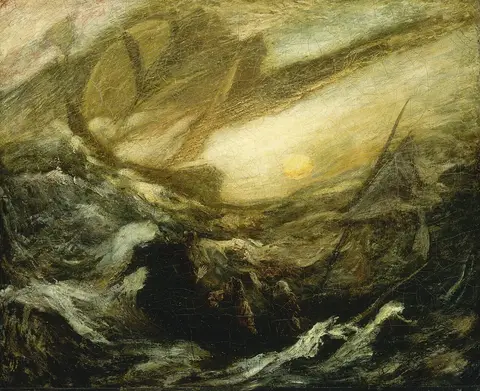
The phantom canoe became one of New Zealand’s most famous stories, painted by Kennett Watkins as The Phantom Canoe: A Legend of Lake Tarawera and retold in Elsie Locke’s children’s book A Canoe in the Mist (1984). At the Buried Village of Te Wairoa, Tūhourangi guides tell the history of the eruption, and Tūhoto Ariki’s whare has been recreated on its original site.
Places to visit
Museum and excavated village with the story of the 1886 eruption and the people of Te Wairoa.
Where it’s reported
The Phantom Canoe of Lake Tarawera in the news
No recent headlines about The Phantom Canoe of Lake Tarawera. Our news desk checks every day — see all the latest paranormal news.
Sources
First published · Updated