Case file · Phantom traveller
The Flying Dutchman
Also known as De Vliegende Hollander, Der Fliegende Holländer, The Phantom Ship of the Cape
The ghost ship doomed to beat against the storms off the Cape of Good Hope forever – the sea’s most famous phantom, from sailors’ yarns to Wagner.
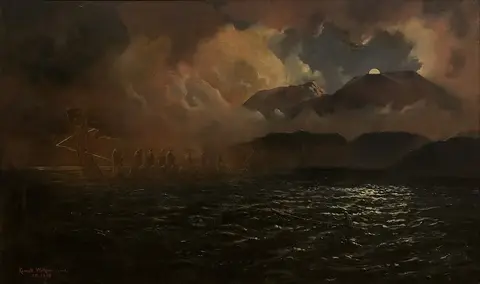
Of all the ghost stories told by sailors, none has travelled further than that of the Flying Dutchman: a Dutch East Indiaman, homeward bound, that tried to round the Cape of Good Hope in a howling gale and never made it. In the best-known telling the captain, refusing to turn back, swears he will round the Cape if he has to keep sailing until Doomsday – and is taken at his word. Ever since, the story goes, the ship has been glimpsed in the waters off southern Africa, under full sail in a dead calm or driving straight into the wind, sometimes glowing with a strange light. To see her was said to foretell disaster.
The legend grew out of a real and frightening stretch of sea. The Dutch East India Company’s route to Java ran round the Cape, where the cold Benguela and warm Agulhas currents meet and sudden storms wrecked many ships; the Portuguese had first called it the Cape of Storms. Popular accounts date the doomed voyage to 1641 and name the captain Hendrik van der Decken, but no captain of that name has been found in the records. Some writers have pointed instead to Bernard Fokke, a 17th-century Dutch skipper so fast on the run to the East Indies that rumour said he had a pact with the Devil.
In print the story is surprisingly young. The earliest known reference is in John MacDonald’s Travels in Various Parts of Europe, Asia and Africa, published in 1790, which describes sailors on a stormy passage off the Cape claiming to have seen the Flying Dutchman. A version attributed to the transported pickpocket George Barrington (A Voyage to Botany Bay, 1795) is thought to be a publisher’s forgery. Walter Scott’s notes to Rokeby (1812) made the ship a pirate vessel cursed for its crimes, and in May 1821 Blackwood’s Edinburgh Magazine published the first full short story, naming the captain Hendrick van der Decken and adding the eerie detail of the crew trying to hand letters to passing ships, addressed to people long dead.
From there the Dutchman sailed into literature and music. Edward Fitzball staged an English melodrama in 1826; Heinrich Heine’s satirical version of 1833 gave the captain a chance of release through a woman’s faithful love; and Richard Wagner turned that idea into his opera Der fliegende Holländer, first performed in Dresden in 1843. Painters such as Albert Pinkham Ryder, novelists such as Frederick Marryat, and in recent decades the Pirates of the Caribbean films have all kept the ship afloat.
Sightings have been claimed into the 20th century. The most famous witness was a future king. In July 1881 Prince George – later George V – and his elder brother Prince Albert Victor were midshipmen on a Royal Navy squadron cruise, travelling in the flagship while their own ship, HMS Bacchante, was repaired. Their journal for 11 July, between Melbourne and Sydney, records that at 4 a.m. “the Flying Dutchman crossed our bows”: a brig some 200 yards off, lit by a strange red glow, which vanished when a midshipman ran forward to look. Thirteen people saw it, and later that morning the seaman who had first reported it was killed in a fall from the rigging. A much-repeated later story, usually dated 1939, tells of bathers near Glencairn and Simon’s Town watching a sailing ship cross False Bay and disappear; its details vary from book to book.
What people report
A sailing ship, often described as an old-fashioned square-rigger, seen under full canvas in calm weather or racing into a gale; a red or pale glow around it; the ship approaching on a collision course and then vanishing; in older tales, a boat lowered from the phantom with crewmen begging passing sailors to carry letters home.
Where and when
Most traditionally off the Cape of Good Hope, Cape Point and False Bay, especially in stormy weather and at night or dawn. Later stories moved the ship around the world – off Australia, in the North Sea and on the Great Lakes – wherever sailors needed a phantom.
Timeline of the haunting
- 1641 (legendary)The doomed voyage Cape of Good Hope
Later tellings set the original voyage in 1641, when a Dutch East India Company ship homeward bound from the East Indies is said to have been lost off the Cape after her captain swore to round it whatever it took. No ship or captain matching the legend has been identified in Company records.
- 1790First appearance in print London
John MacDonald’s travel memoir describes sailors on a stormy passage off the Cape talking of seeing the Flying Dutchman – the earliest known written reference to the legend.
- May 1821The story takes shape Edinburgh
Blackwood’s Edinburgh Magazine publishes “Vanderdecken’s Message Home,” naming the captain and introducing the crew’s unanswerable letters. Most later versions follow it.
- 2 January 1843Wagner’s opera premieres Dresden, Germany
Richard Wagner’s Der fliegende Holländer opens at the Royal Saxon Court Theatre, giving the legend its most enduring form: a captain who may be freed only by a faithful love.
- 11 July 1881A prince sees the phantom ship Off the coast of Victoria and New South Wales, Australia
The princes’ journal records a red-lit phantom brig crossing the bows of the squadron’s flagship at 4 a.m., seen by thirteen people, including the lookout and the officer of the watch. The entry was published in The Cruise of Her Majesty’s Ship “Bacchante,” 1879–1882 (1886).
What could explain it?
- Superior mirages and the Fata Morgana: over cold water, layers of warm air can bend light so that a ship far below the horizon appears floating in the air, upside down or stretched – a common effect off the Cape, where cold and warm currents meet. Most scientists regard this as the likeliest source of sightings.
- Looming: a related refraction effect can make a distant ship look much larger and nearer than it is, then ‘vanish’ when the air layers shift.
- Ordinary ships seen badly: in fog, spray or poor light, a real vessel can appear and disappear suddenly, and a ship sailing on a different wind far off can look as if it is defying the weather.
- Literary feedback: the legend’s best-known details – the cursed captain, the letters, the redemption – come from magazine fiction, the stage and Wagner, and later witnesses described the ship they had read about.
- Sailors’ culture: the Cape was genuinely deadly, and ghost-ship yarns were part of shipboard storytelling, entertainment and warning for new hands.
Ghost tours, books and screen
Wagner’s opera remains in the repertoire of opera houses worldwide. The legend inspired Frederick Marryat’s novel The Phantom Ship (1839), Albert Pinkham Ryder’s painting in the Smithsonian American Art Museum, the 1951 film Pandora and the Flying Dutchman and the ship of Davy Jones in Pirates of the Caribbean. At Cape Point the funicular railway to the old lighthouse is named the Flying Dutchman, and the ghost ship is part of the Cape Peninsula’s tourist lore.
Places to visit
The cliffs and lighthouses at the tip of the peninsula look out over the waters where the phantom ship is said to sail; the Flying Dutchman funicular runs up to the old lighthouse.
Where it’s reported
The Flying Dutchman in the news
No recent headlines about The Flying Dutchman. Our news desk checks every day — see all the latest paranormal news.
Sources
First published · Updated