Case file · Shadow figure · Prison or jail
West Virginia Penitentiary
Also known as Moundsville Penitentiary, West Virginia State Penitentiary
A Gothic stone fortress that held West Virginia’s prisoners from 1876 to 1995, scene of 94 executions and a 1986 riot. Guides tell of a “shadow man.”
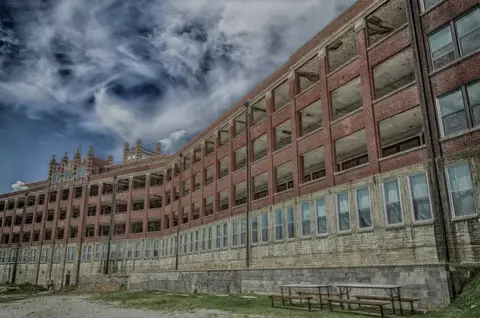
When West Virginia broke away from Virginia during the Civil War, it had no state prison. After a run of escapes from county jails, the legislature bought ten acres just outside Moundsville in 1866 and set convicts to building a castellated Gothic penitentiary from local sandstone, modelled at half the scale on the 1858 state prison at Joliet, Illinois. The North Wagon Gate was finished in 1876; behind the 24-foot walls stood a South Hall of tiny four-by-seven-foot cells, a North Hall with chapel, kitchen and hospital, and a central tower where the warden’s family lived above the women prisoners.
In its early decades the prison was nearly self-sufficient, with workshops, a farm and, from 1921, a coal mine, and a school and library opened in 1900. Its inmates included the labour leader Eugene V. Debs in 1919 and Edward Shue, convicted in the Greenbrier Ghost case, who died there in 1900. But overcrowding grew – by the 1920s more than 2,000 men were held in a prison built for far fewer – and so did violence. Between 1899 and 1959, 94 men were executed here, 85 by hanging and nine in an electric chair built by an inmate. In November 1979 fifteen prisoners escaped and one of them shot and killed off-duty State Trooper Philip Kesner; on New Year’s Day 1986 an inmate group took hostages in a two-day riot in which three prisoners died.
That year the state’s Supreme Court of Appeals ruled that confinement in the old cells was cruel and unusual punishment, and the penitentiary closed on March 27, 1995. Since then it has been run for tourism, training and events – including an annual mock prison riot for corrections officers, overnight paranormal investigations and a Halloween haunted house. Guides cite 36 confirmed homicides inside the walls; one of the best-known victims, inmate No. 44670, R.D. Wall, is said to have been stabbed to death by three fellow prisoners in the boiler-room area in 1929 for informing on them. That is the date most accounts give, though a few retellings place it in 1979, and no contemporary record of the killing has been published.
The prison’s ghost stories gather around such deaths. Staff describe a figure in khaki walking toward the boiler room, a “shadow man” glimpsed and photographed on the tiers, faces at windows and voices in empty cells. MTV’s Fear filmed its first episode here, and paranormal TV has returned often. Tour guides are candid that the stories sit beside a grim, real history of violence, poverty and punishment – and that many visitors come for that history alone.
What people report
Shadowy human figures caught on camera and glimpsed on the tiers, a man in khaki who walks toward the boiler room and vanishes, a face at the window of the old visitation room, the sound of handcuffs clicking, footsteps, conversations and slamming cell doors, doors opening by themselves, cold spots, and visitors reporting being grabbed or having their names whispered.
Where and when
The North Hall and oldest cellblocks, the boiler room and basement passages, the old visitation rooms and the death row and execution areas. Flashlight and overnight tours focus on the north end, which staff say is most active.
Timeline of the haunting
- 1876The penitentiary is completed Moundsville, West Virginia
Built with convict labour from local sandstone, the castellated prison opens its North Wagon Gate and cellblocks.
- April 1919Eugene V. Debs imprisoned Moundsville, West Virginia
The labour leader serves two months here after his conviction under the Espionage Act, before transfer to Atlanta.
- November 7, 1979The mass escape Moundsville, West Virginia
Fifteen inmates break out; escapee Ronald Turney Williams kills off-duty Trooper Philip S. Kesner outside the walls.
- January 1, 1986The New Year’s Day Riot Moundsville, West Virginia
Inmates take officers hostage in a two-day uprising over conditions; three inmates are killed.
- March 27, 1995The prison closes Moundsville, West Virginia
After a court ruled the cells unconstitutional, the last inmates are transferred and the site later reopens for tours.
What could explain it?
- Large stone cellblocks echo and amplify sound; footsteps, voices and door noises from other tour groups and staff carry unpredictably.
- Shadow figures in photos are often the product of low light, long exposures and pareidolia, especially in places visitors expect to be haunted.
- Guides and paranormal tours encourage visitors to “provoke” spirits, which raises expectations and suggestibility.
- Details of key stories, such as the date and place of R.D. Wall’s death, vary between retellings and rest on tour lore rather than published records, a sign of oral tradition at work.
Ghost tours, books and screen
The penitentiary was the setting for the first episode of MTV’s Fear (2000), has appeared on Ghost Adventures and Science Channel’s Mysteries of the Abandoned, and features in films and video games. It hosts tours, a haunted house, escape rooms and the annual Mock Prison Riot.
Places to visit
Guided history tours, photography tours, overnight paranormal investigations and seasonal haunted attractions.
Where it’s reported
West Virginia Penitentiary in the news
No recent headlines about West Virginia Penitentiary. Our news desk checks every day — see all the latest paranormal news.
Sources
First published · Updated