Case file · Residual haunting · Prison or jail
Fort Smith National Historic Site
Also known as Judge Parker’s courthouse, Hell on the Border jail, Fort Smith federal court
The old federal courthouse and jail of Judge Isaac Parker, where gallows ropes and a courtroom gavel are said to stir with no one there.
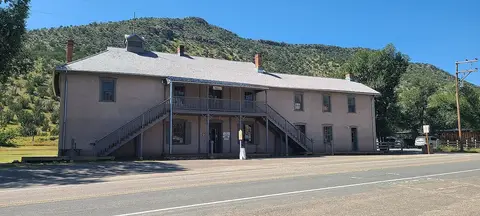
Fort Smith began as a frontier army post at Belle Point, where the Poteau River meets the Arkansas, and its second fort was built in the late 1830s. After the army left, the old barracks building was turned over to the courts. In November 1872 the federal court for the Western District of Arkansas moved onto the fort grounds, and in 1875 a thirty-six-year-old former Missouri congressman, Isaac C. Parker, took the bench. He held it until 1896, handling an enormous docket of cases from the Indian Territory just across the river and earning the nickname “the Hanging Judge.” A newsletter of the Arkansas courts credits him with more than 13,000 cases and 160 death sentences, of which 79 were actually carried out on the gallows beside the courthouse. The National Park Service stresses that many of the legends around him are uncertain.
Conditions for the prisoners were a scandal even in their own time. The first jail was the courthouse basement, a pair of damp rooms with little air; the park’s account notes that the floors were kept wet, that each cell had a single chamber pot, and that in June 1885 a hundred and nine men, accused murderers among them, were crowded together without separation. Anna Dawes, who described the cells, called it a “veritable hell upon earth.” Congress paid for a new jail in 1886, and prisoners moved into it in March 1888. The nickname “Hell on the Border” stuck to the whole complex, and the gallows – reconstructed today on the grounds – became its most famous image.
The ghost stories are tied to that history. The Arkansas court system’s own newsletter, in a 2014 feature on haunted courthouses, repeats the local belief that the ropes on the gallows can be seen swinging even when the air is still, and that a gavel can be heard banging in the old courtroom when no one is inside. Other accounts mention disembodied voices, cold spots and uneasy feelings in the jail beneath the courthouse, mostly from visitors and a small body of regional ghost-book and travel writing. The park itself does not promote the stories, and it prefers to interpret the real men and women connected to the site, including condemned prisoners such as Crawford Goldsby, known as Cherokee Bill, who was hanged on 17 March 1896.
Reports at Fort Smith are, in other words, less a single famous case than a steady local reputation that follows the building’s purpose. Visitors who tour the restored courtroom and jail often arrive primed by the nickname. The usual skeptical reading is that an old basement with poor ventilation, drafts through a reconstructed timber structure and sounds carried through brick and wood supply plenty of ordinary noise, while the weight of the real history – executions, overcrowding and disease – does the rest. The place is best approached as a serious historic site about frontier justice rather than as a haunted attraction.
What people report
Gallows ropes said to sway in still air, a gavel heard from the empty courtroom, voices, cold spots and a sense of being watched in the basement jail; reports come from visitors and local ghost-story writers.
Where and when
The reconstructed gallows, the old courtroom upstairs and the basement jail beneath the former barracks and courthouse building, now the visitor center.
Timeline of the haunting
- November 1872Federal court moves onto the fort Fort Smith, Arkansas
The Western District court relocates from Van Buren to the old barracks building, which is converted into a courtroom with a jail in the basement.
- June 1885A hundred and nine men in the basement jail Fort Smith, Arkansas
The overcrowded, damp jail holds 109 men without separating those accused of murder from lesser offenders, helping earn the name “Hell on the Border.”
- March 1888Prisoners move into the new jail Fort Smith, Arkansas
A new jail, authorised by Congress in 1886, opens beside the courthouse after a year of construction.
- 17 March 1896Cherokee Bill hanged Fort Smith, Arkansas
Crawford Goldsby, one of the best-known outlaws sentenced by the court, is executed on the gallows; Judge Parker leaves the bench the same year.
- October 2014Arkansas courts record the legend Little Rock, Arkansas
The Arkansas Court News features the swinging ropes and banging gavel in a roundup of the state’s reputedly haunted courthouses.
What could explain it?
- Setting and expectation: a building famous as the home of a “hanging judge” primes visitors to interpret creaks, drafts and echoes as something more.
- Folklore from the nickname: the phrase “Hell on the Border” was coined in the 19th century about real conditions, and later storytellers attached supernatural details to it.
- Ordinary causes: reconstructed timber, wind off the river and old masonry carrying sound can move ropes and produce knocks, while basements are naturally damp, cold and poorly ventilated.
- Thin documentation: the reports come from visitors, local ghost-book authors and a courts newsletter rather than controlled investigations, and the National Park Service does not confirm them.
Ghost tours, books and screen
Judge Parker and his deputy marshals are central to Wild West lore, from Charles Portis’s novel True Grit to several film versions. Local ghost tours and books on Fort Smith and Van Buren mention the courthouse and jail.
Places to visit
National Park Service visitor center in the restored courthouse and jail, with a reconstructed gallows and exhibits on Judge Parker, the deputy marshals and the Trail of Tears.
Where it’s reported
Sources
First published · Updated