Case file · Haunted object · Prison or jail
Old Jail Museum (Carbon County Jail)
Also known as Carbon County Jail, The Old Jail, Jim Thorpe, Cell 17 handprint
In the 1870 jail where accused Molly Maguires awaited the gallows, a handprint on the wall of Cell 17 is said to return however often it is painted over.
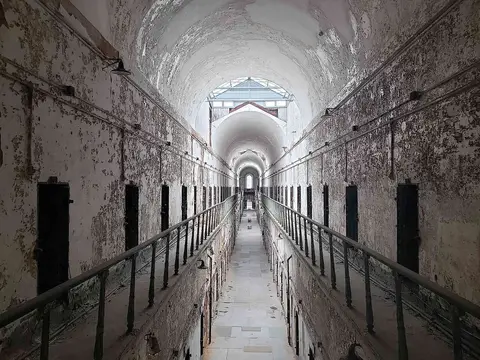
The fortress-like stone jail on Broadway in Jim Thorpe – the town was called Mauch Chunk until 1953 – was built in 1869–70 for Carbon County and served as its prison until January 1995. It is remembered above all for the Molly Maguires: Irish immigrant coal miners accused of belonging to a secret society behind a wave of killings of mine bosses during the brutal labour conflicts of the 1870s anthracite fields. Their prosecution leaned heavily on a Pinkerton detective working undercover for the coal and railroad interests, and the trials are still debated by historians.
On June 21, 1877 – remembered locally as the “Day of the Rope” – Alexander Campbell, Michael Doyle, Edward Kelly and John Donahue were hanged together on a scaffold inside the jail, while six more men were hanged the same day at Pottsville. Thomas Fisher, James McDonnell and Charles Sharpe followed on the same gallows in 1878 and 1879. In 1979 Pennsylvania granted a posthumous pardon to another accused leader, John “Black Jack” Kehoe, and the governor called the men “martyrs to labor,” which hardened the local view that at least some of the condemned had been wrongly convicted.
The jail’s legend grew from that sense of injustice. According to the story, one of the condemned men pressed his dirty hand against the wall of Cell 17 and declared that the mark would remain as proof of his innocence. Tradition long named Alexander Campbell; the museum’s owners now say it was believed to be Thomas Fisher, while acknowledging research that points back to Campbell. Wardens are said to have washed, painted and even replastered the wall, only for the print to reappear.
In 1994, as the county prepared to close the jail, two forensic scientists hired by the television series Unsolved Mysteries examined the mark, taking paint samples and infrared and ultraviolet photographs; one of them told the Associated Press that the study would probably neither prove nor disprove the legend. Local residents Thomas and Betty Lou McBride bought the building for $160,000 and opened it as a museum, and their family still runs tours of the cellblock, the basement solitary cells known as the Dungeon and the reconstructed gallows. Ghost stories are part of the tour, but the museum bans ghost-hunting equipment.
What people report
The central claim is the handprint itself, said to survive every attempt to remove it. Visitors and staff also describe cold spots, footsteps and voices in the cellblock, and a heavy atmosphere in the basement solitary cells, which many link to the executed men.
Where and when
Cell 17 on the main cellblock, now sealed and viewed through its door window; the basement Dungeon; and the spot in the cellblock where the gallows stood.
Timeline of the haunting
- June 21, 1877The “Day of the Rope” Jim Thorpe, Pennsylvania
Four accused Molly Maguires, including Alexander Campbell, are hanged inside the Carbon County Jail. Legend holds that one condemned man left his handprint on the wall of Cell 17 as a sign of his innocence.
- 1979A posthumous pardon Pennsylvania
Governor Milton Shapp pardons John “Black Jack” Kehoe after a review by the state Board of Pardons, reinforcing doubts about the Molly Maguire trials.
- June 1994Unsolved Mysteries tests the print Jim Thorpe, Pennsylvania
Police chemist Jeff Kercheval and Professor James Starrs of George Washington University sample the paint and photograph the mark under infrared and ultraviolet light. Kercheval predicts the legend will be hard to prove or disprove.
- January 1995The jail closes and becomes a museum Jim Thorpe, Pennsylvania
The last prisoners are moved to a new county facility. The McBride family buys the building and opens it to the public as the Old Jail Museum.
What could explain it?
- Stains from soot, oils or minerals in old plaster commonly bleed through fresh paint, so a mark that “comes back” is a familiar problem for restorers.
- Descriptions of how the wall was repainted or rebuilt come from oral tradition rather than documented records.
- The museum itself is unsure whose hand made the mark, which shows how the story has shifted over time.
- The jail’s real history of executions and contested trials gives visitors strong expectations of a haunting.
Ghost tours, books and screen
The handprint featured on Unsolved Mysteries and is a staple of Pennsylvania ghost guides. The Molly Maguires inspired the 1970 film The Molly Maguires, and the museum’s owners have written books on the trials and the jail’s ghost stories. Jim Thorpe itself draws visitors to its Victorian downtown and the nearby Harry Packer and Asa Packer mansions.
Places to visit
Family-run museum with guided tours of the cellblock, Cell 17 and the Dungeon, open roughly May to October.
Where it’s reported
Old Jail Museum (Carbon County Jail) in the news
No recent headlines about Old Jail Museum (Carbon County Jail). Our news desk checks every day — see all the latest paranormal news.
Sources
First published · Updated