Case file · Other · House or mansion
Patience Worth
Also known as Pearl Curran Ouija case, The Patience Worth communications
A St. Louis housewife and a Ouija board produced novels and poems from a self-declared 17th-century spirit, a case that puzzled scholars for decades.
Patience Worth is one of the strangest cases in American spiritualism, because it left behind a vast written record. Pearl Lenore Curran, born Pearl Pollard in Mound City, Illinois, in 1883, moved to St. Louis as a girl, married John H. Curran in 1907 and, by most accounts, had little formal education beyond elementary school and some voice training. In July 1912 she and her friend Emily Grant Hutchings, a writer, began to use a Ouija board at the Curran home for amusement. After early messages that claimed to be from relatives and seemed unremarkable, a different voice appeared on 8 July 1913 with the words “Many moons ago I lived. Again I come. Patience Worth my name.”
The voice said that she had lived in the seventeenth century, giving the year 1649, that she was born in England, crossed the sea and was killed by Native Americans, though she gave few details of her life and preferred to teach. From that evening the sessions grew into a circle of friends and visitors in the Curran home, with John Curran or Pearl’s mother taking down every word. Pearl did not enter a trance; she could chat while her hand moved the pointer, and she later dropped the board and dictated by what she called clairvoyance and clairaudience. In total she produced seven novels, plays, short stories, thousands of poems and countless aphorisms. The long Biblical novel The Sorry Tale appeared in 1917, Hope Trueblood, a story set in Victorian England, in 1918, and in 1918 some of the poems appeared in a respected poetry anthology.
The case drew attention when Casper Yost, Sunday editor of the St. Louis Globe-Democrat, began to attend in October 1914 and wrote a feature and then a book in 1916. William Marion Reedy of Reedy’s Mirror vouched for the honesty of the sittings but thought a secondary personality was the more likely author. The researcher Walter Franklin Prince spent about ten months with Curran and published a 509-page report in 1927 that left open a cause beyond the ordinary subconscious. James Hyslop dismissed the case as fraud in 1916, and the psychologist Joseph Jastrow and later sceptics such as Joe Nickell argued that Patience was a persona of Curran’s own mind. Critics point out that no historical Patience Worth was ever identified and that the name appears as a minor maid in a 1900 novel, To Have and to Hold, though Curran said she had not read it.
The communications continued until Curran’s death in California in 1937. Today the 29 volumes of transcripts, with other papers, sit in the Missouri Historical Society Library and Research Center in St. Louis, and the case is studied as an example of what the mind can do in an altered state. Patience is not a ghost in the sense of a place’s resident, but the story is part of the American tradition of haunting-by-writing: a presence that arrived through a board, claimed an older life, and spoke in a voice of great literary power.
What people report
A purported seventeenth-century voice communicated through a Ouija board and later through dictation, producing novels, poems and plays in an archaic English mixing dialects. No apparitions or physical phenomena are reported.
Where and when
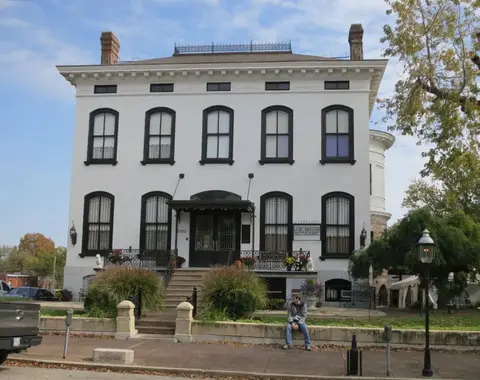
The Curran home in St. Louis, where the sessions were held (a private residence; no address is given here).
Timeline of the haunting
- July 1912Ouija sessions begin St. Louis, Missouri
Pearl Curran and Emily Grant Hutchings begin to use a Ouija board, receiving messages that claim to come from relatives.
- 8 July 1913Patience Worth introduces herself St. Louis, Missouri
The board spells out a message from “Patience Worth,” who says she lived “many moons ago” and gives the year 1649.
- 1916Casper Yost publishes the first book St. Louis, Missouri
The journalist’s book Patience Worth: A Psychic Mystery introduces the case to a national audience.
- June 1917The Sorry Tale appears St. Louis, Missouri
The 644-page novel about the last days of Jesus is published and praised by some scholars.
- 1927Walter Franklin Prince’s report St. Louis, Missouri
After about ten months of study, Prince publishes a 509-page analysis that considers the subconscious and other explanations.
- 1937Pearl Curran dies California
The communications end with Curran’s death; the transcripts later go to the Missouri Historical Society.
What could explain it?
- Most psychologists treat Patience as a dissociated or secondary personality of Curran: creative work produced in an altered state, with a persona that allowed her to voice opinions she might not otherwise have expressed.
- Cryptomnesia – the unconscious recall of material read or heard long ago – is another proposal; the Psi Encyclopedia notes that passing exposure and a good memory might account for some of the vocabulary, though Curran’s limited reading is cited against it.
- No seventeenth-century Patience Worth has been found; critics point to a fictional character of that name and to a mix of dialects and periods that would not belong to a single person.
- Believers answer that the speed of the dictation, the accuracy of the archaic vocabulary and Curran’s modest education go beyond ordinary improvisation, as Prince put it; the case remains unresolved.
Ghost tours, books and screen
The case was a sensation of the 1910s, drew the attention of newspaper editors and psychologists, and is often cited in histories of the Ouija board and of American spiritualism.
Places to visit
The society holds the Patience Worth Collection, including 29 volumes of transcripts, open to researchers.
Where it’s reported
Sources
First published · Updated