Case file · Ghost light · Road, bridge or woods
The Hornet Spooklight
Also known as Spooklight, Joplin Spook Light, Hollis Light, Tri-State Spooklight, Devil’s Promenade
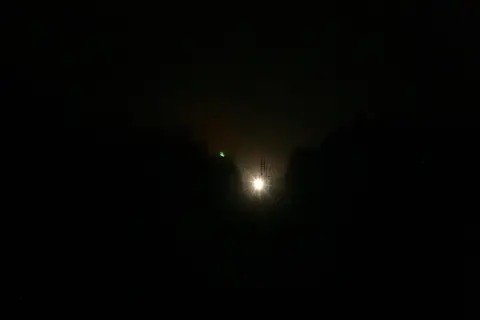
A glowing orange ball seen from Spooklight Road on the Missouri–Oklahoma line, tested for decades and traced by skeptics to Route 66 headlights.
Near the point where Missouri, Oklahoma and Kansas meet, at the edge of the old Tri-State lead-and-zinc mining district, a gravel farm road known as E 50 Road, or Spooklight Road, has drawn night-time watchers for generations. Looking west from a few miles outside Hornet, Missouri, between about ten at night and midnight, visitors report an orange, fire-like ball roughly the size of a baseball or basketball that hovers near the horizon, drifts, flickers, splits into several lights and then vanishes. It goes by many names: the Hornet Spooklight, the Joplin Spook Light, the Hollis Light, the Tri-State Spooklight, and, in local legend, the Devil’s Promenade.
The stories explaining it are older than the evidence for it. In one telling, the light is the lantern of a miner searching for his lost wife and children; in another it is the spirit of a Quapaw maiden and her lover who leapt into the Spring River; in another a murdered Osage chief wanders with a lantern looking for his head. Some tellers date the first sighting to the Trail of Tears in 1836 or to an 1881 pamphlet called Ozark Spook Light, but researcher Paul W. Johns found no print mention before 1926, the year this stretch of Route 66 was designated, and the pamphlet has never been produced. The earliest widely cited printed description is by A. B. MacDonald in the Kansas City Star in January 1936, and Vance Randolph recorded the legend in Ozark Magic and Folklore in 1947. The Native American legends cannot be traced in early sources, and should be read as folklore told about, rather than by, the Quapaw and Osage nations.
Because the light is so easy to reach, it has been tested again and again. MacDonald suggested in 1936 that it came from headlights on Route 66, which runs through a bend south of Quapaw, in line with the farm road about ten miles to the east. In 1945–46 Dr George W. Ward proposed that cold air over the Spring River created a superior mirage, and Army Major Thomas Sheard had a car flash its headlights on a distant road while observers saw the light appear and vanish in step. In 1955 eight young men from Kansas City used a telescope and saw several lights rather than one. In 1965 Robert Gannon, writing for Popular Mechanics, repeated the test and showed that the single light was a pair of headlights. Promoters did not always welcome such findings: a 1969 chamber-of-commerce release wrongly claimed scientists could not explain it.
Not everyone is convinced. Visitors continue to describe lights that split, change colour, approach cars or appear when no car is on the highway, and ghost-lore pages still list other hypotheses, from natural gas to electrical charges along a fault. For most researchers the matter is settled, but the Spooklight keeps its place as a roadside ritual for teenagers, tourists and Route 66 travellers. If you go, stay on the public road, respect the farms around it, and remember that headlights on the highway are part of the show.
What people report
A single glowing orange or white ball at the western horizon that hovers, flickers, swells, splits into several lights, changes colour and disappears. Some witnesses say it has moved toward cars or appeared with no vehicle on the road; no apparition is reported.
Where and when
Looking west along E 50 Road (Spooklight Road) near Hornet, Missouri, from about 10 p.m. to midnight; the light appears over the Oklahoma horizon, near Quapaw.
Timeline of the haunting
- 1926Route 66 designated Quapaw, Oklahoma
The highway through the area was designated; researcher Paul Johns found no printed Spooklight account earlier than this year.
- January 1936Kansas City Star describes the light Kansas City, Missouri
A. B. MacDonald’s article first described the effect in print and suggested distant headlights as the cause.
- 1946Mirage experiment Hornet, Missouri
Army Major Thomas Sheard had a car flash its headlights on a distant road while observers saw the light vanish and return in step.
- 1955Telescope test by Kansas City youths Hornet, Missouri
Eight young men viewed the light through a telescope and saw several lights, not one.
- September 1965Popular Mechanics investigation Hornet, Missouri
Robert Gannon repeated the test and showed that the “single” light was a pair of headlights.
What could explain it?
- Car headlights on Route 66 south of Quapaw line up with Spooklight Road about ten miles away across the Spring River; cold air over the river can produce a superior mirage that makes distant lights hover, shimmer and split.
- Several staged tests with headlights, flares and spotlights in 1946, 1955, 1965 and 2015 made the light appear, vanish or change in step with cars.
- Claims that the light predates cars have no supporting early documents; the often-cited 1881 pamphlet has not been found.
- The legends were promoted by local businesses and chambers of commerce for tourism, and some press releases overstated the mystery.
- Ideas such as natural gas, ball lightning or electrical discharges along a fault line are proposed on ghost-lore sites but have no good evidence.
Ghost tours, books and screen
The Spooklight is a staple of Route 66 and Four States folklore, recorded by Vance Randolph in 1947, tested by Popular Mechanics in 1965 and featured in Skeptoid and regional travel writing. Local businesses have long sold it as a roadside attraction.
Places to visit
Public gravel road for night viewing, usually from 10 p.m.; stay on the road and respect neighbours’ property.
Where it’s reported
Sources
First published · Updated