Case file · Haunted object · Town or district
The Ouija Board’s Baltimore Birth
Also known as Kennard Novelty Company, Helen Peters and the Ouija patent
A Baltimore medium helped win the 1891 Ouija patent by showing the board could spell; its makers were real people with real feuds.
The Ouija board is the most famous object of the Spiritualist era, and its commercial birth took place in Baltimore. Talking boards had been used by mediums after the Civil War, and in 1886 newspapers reported a craze for them in Ohio. A Chestertown, Maryland, fertiliser salesman named Charles Kennard, with a furniture maker and undertaker named E. C. Reiche, made boards of their own. In 1890 Kennard moved to Baltimore and incorporated the Kennard Novelty Company the day before Halloween with the backing of local lawyer Elijah Bond.
According to accounts based on the work of talking-board historian Robert Murch, Bond’s sister-in-law Helen Peters, a Baltimore medium, was at the centre of the story. The local patent office is said to have been unconvinced, and Peters went with Bond to Washington, where she is reported to have shown the chief patent officer that the planchette would spell out his name. The patent was granted on 10 February 1891. The board’s own account of its name, that it spelled out “Ouija” and meant “good luck,” is a promotional story; one popular version says the word came from a locket Peters wore, bearing a picture of the novelist Ouida.
The business soon passed to William Fuld, an employee and investor who built a fortune manufacturing boards in Baltimore. He fell out with his brother Isaac, which led to lawsuits and a rival board called the Oriole; their descendants did not speak for decades. Fuld described himself as a Presbyterian, not a Spiritualist, though he said the board had told him to build his factory. In 1927 he died after a fall from the factory roof when a railing gave way. The family sold the business to Parker Brothers decades later.
Researchers do not describe the Ouija board as a haunting in the strict sense. It is an object linked in popular belief to contact with spirits, and in this entry the evidence is about people: a medium, an attorney, a failed salesman and a manufacturer, and the uncertain tales they told to sell a product.
What people report
Claims that spirits move a planchette to spell messages; the Baltimore story includes the report that the board spelled out a patent officer’s name.
Where and when
Baltimore, Maryland, where the Kennard Novelty Company was set up in 1890 and Fuld later ran his factory.
Timeline of the haunting
- 1886Ohio talking-board craze reported Ohio
Newspapers report talking boards spreading through Spiritualist circles, which probably inspired Kennard and Reiche.
- 30 October 1890Kennard Novelty Company incorporated Baltimore, Maryland
Kennard and local backers, including attorney Elijah Bond, incorporate the firm.
- 10 February 1891Patent granted Washington, D.C.
The patent is granted after the board reportedly passed a demonstration by medium Helen Peters.
- 1927William Fuld dies Baltimore, Maryland
The manufacturer dies in a fall at his factory.
What could explain it?
- Ideomotor effect: Michael Faraday and William Carpenter showed in the 1850s that unconscious muscle movements can move table-turning devices, and the same effect is the accepted explanation for planchettes.
- The demonstration at the patent office rests on the inventors’ own later accounts, not an independent record.
- The “oui” and “ja” origin of the name is a modern myth, and the locket story is itself unverified.
Ghost tours, books and screen
The Ouija board is a staple of horror films and of Parker Brothers history; Baltimore’s Spiritualist past is the subject of talks and walking tours by local libraries.
Places to visit
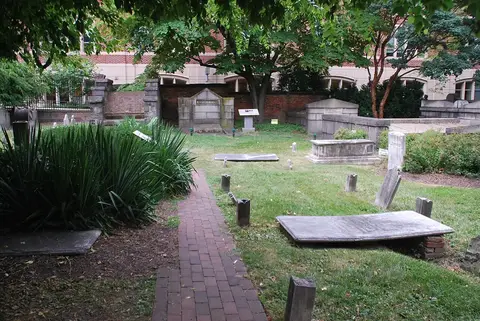
Historic cemetery where Elijah Bond is buried; visit by day.
Where it’s reported
Sources
First published · Updated