EXPLAINER · GHOST-HUNTING GEAR
What ghost-hunting gear really measures, and what it can’t
EMF meters, spirit boxes and EVP recorders are the props of every ghost hunt. Here is what each one actually detects, and what experiments say about them.
Watch any ghost-hunting show and the same tools appear: a meter with a row of colored lights, a radio that spits out bursts of noise, a voice recorder left running in an empty room, a thermal camera glowing purple and orange. They look scientific, and that is part of their appeal. But every one of these devices was built to measure something ordinary. Understanding what that is makes ghost hunts more interesting, not less.
EMF meters: wiring detectors with lights
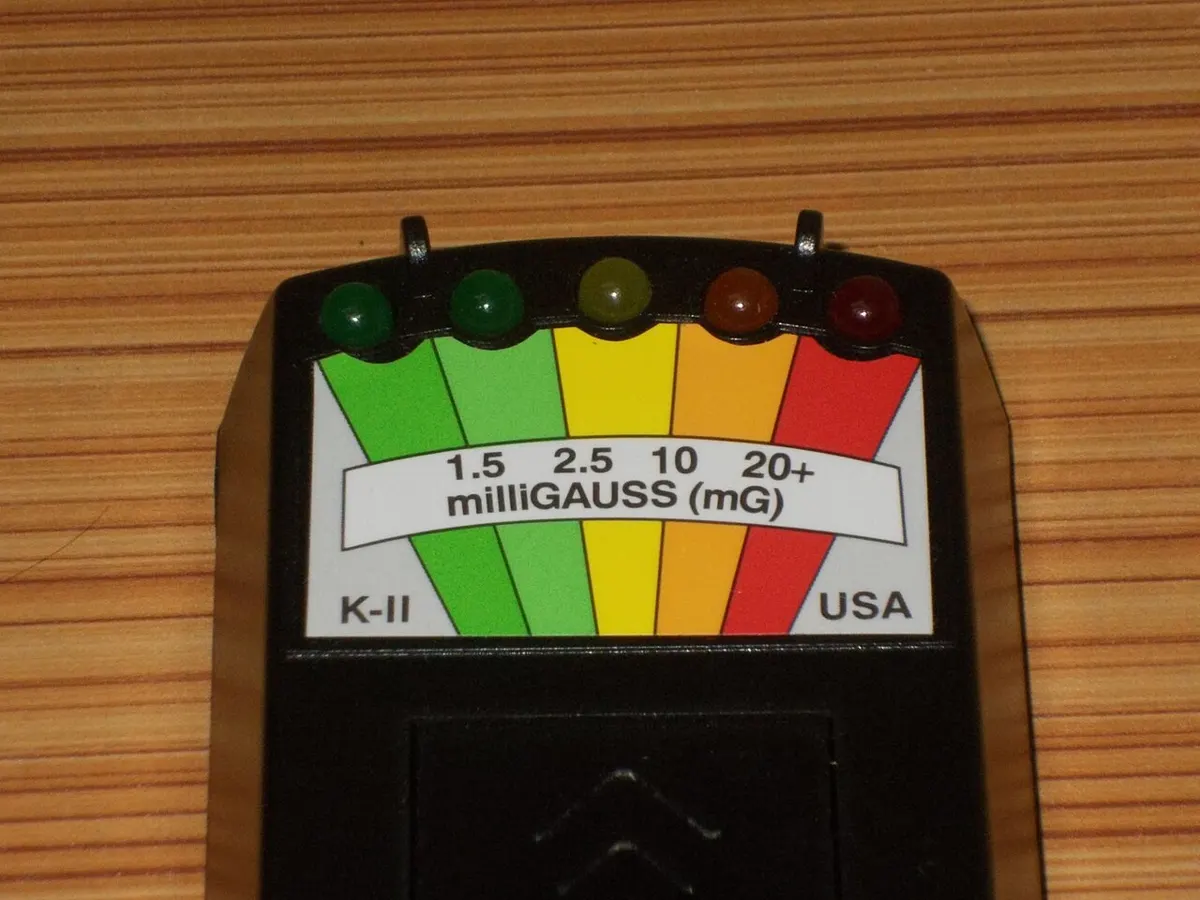
The most common gadget is the EMF meter, which measures electromagnetic fields. The University of Warwick electrical engineer Marina Antoniou, asked about ghost-hunting kit in 2023, explained that these fields usually come from human-made sources such as household wiring and power lines, and that gaussmeters are simply more sensitive versions normally used to check safety limits. As she put it, a sudden spike “could relate to something paranormal or just wiring!”
The K-II, shown above, is the classic model: five LEDs that light up as the field rises, on a scale marked in milligauss. Wikipedia’s survey of ghost-hunting equipment notes that one brand became popular after Ghost Hunters described it as specially calibrated for paranormal investigators, and that critics put its appeal down to bright lights and frequent false positives. Joe Nickell, a longtime investigator for the Committee for Skeptical Inquiry, has listed faulty wiring, phone signals and nearby transmitters among the usual causes of EMF readings.
There is no established reason to think ghosts produce electromagnetic fields. The idea borrows from research suggesting that fields might affect people. In a 2003 study published in the British Journal of Psychology, Richard Wiseman and colleagues found that the places where volunteers reported odd experiences at Hampton Court Palace and in Edinburgh’s South Bridge Vaults were linked to variations in the local magnetic field and to lighting levels. Their conclusion was that people may be responding to normal features of their surroundings. Later reviews, such as one by the psychologist Jason Braithwaite in 2008, questioned whether weak fields have any such effect at all. Either way, the meter is measuring the room, not a spirit.
Thermal cameras and cold spots
Thermal cameras and infrared thermometers are used to hunt for “cold spots.” Both measure the temperature of surfaces, not the air, so a cold window pane, a damp wall or a draft from a gap under a door will all show up as a blue patch. That is useful for finding where heat escapes from an old building, but it says nothing about who might be standing there.
EVP: voices in the noise
Electronic voice phenomena, or EVP, are voices that people say they hear on recordings that sounded silent at the time. The idea goes back to 1959, when the Swedish painter and film producer Friedrich Jürgenson said he heard the voices of his dead father and wife on tapes of birdsong. Konstantīns Raudive later made more than 100,000 recordings and described them in his book Breakthrough, published in English in 1971.
Michael Nees, a psychologist at Lafayette College, tested how people hear EVP. As he described in The Conversation in 2015, telling volunteers they were taking part in a paranormal study raised the share who heard a voice in ambiguous EVP clips from 34% to 48%. When people did hear a voice, only 13% agreed on what it said, compared with 95% for real speech, and their versions matched the paranormal researchers’ interpretations less than 1% of the time. Nees called EVP “an auditory example of pareidolia” – the same tendency that makes us see faces in clouds.
Other checks point the same way. Wikipedia’s summary of EVP research notes that the psychologist Imants Barušs recorded 60 hours of radio static over 81 sessions in the late 1990s and found voice-like sounds, but nothing he could call clearly anomalous. Stray radio broadcasts, baby monitors, over-amplified recordings and noise-reduction software can all add voice-like sounds of their own.
Spirit boxes: radios that never settle
The spirit box, or ghost box, is a radio that sweeps continuously through AM and FM stations. Antoniou described the belief behind it: that spirits can manipulate the stream of fragments to form words. The device became popular after an enthusiast named Frank Sumption built his “Frank’s Box” in 2002. Because it is playing real broadcasts, it produces a constant flow of syllables and half-words, which is exactly the material the brain uses to find speech. The writer Benjamin Radford has called it a modern version of the Ouija board. Some newer devices, such as the Ovilus, skip the radio and pick words from a built-in list of 2,048, according to a 2021 analysis in Anthropology News.
Why the gear persists
In a 2012 study described in the Skeptical Inquirer, Sharon Hill, a consultant to the Committee for Skeptical Inquiry, looked at about 1,000 amateur investigation groups online. Of the 879 focused on ghosts, 526 described themselves as scientific, though few showed much sign of scientific method. Equipment, she argued, worked as a symbol of rigor. Investigators who want to use it well can borrow some basics from real science: take baseline readings, log every electrical source, record in pairs and have someone who doesn’t know where a clip was made listen to it first. When the skeptic Kenny Biddle and colleagues ran a careful overnight EVP session at White Hill Mansion in 2018, they recorded no answers at all.
Sources
- University of Warwick: Ghost Hunting Equipment – What you need to know according to an electricity expert (Oct. 23, 2023)
- The Conversation: Michael Nees, Hearing ghost voices relies on pseudoscience and fallibility of human perception (Oct. 30, 2015)
- Wiseman et al., An investigation into alleged ‘hauntings’, British Journal of Psychology 94 (2003) – University of Edinburgh research portal
- University of Birmingham: Braithwaite, Putting magnetism in its place (Journal of the Society for Psychical Research, 2008)
- Skeptical Inquirer: Sharon Hill, Amateur Paranormal Research and Investigation Groups Doing ‘Sciency’ Things (March/April 2012)
- Skeptical Inquirer: Kenny Biddle, Challenging Claims of Electronic Voice Phenomena (Sept. 17, 2018)
- Anthropology News: Dylan Anderson, Creating Proof of Ghosts (Oct. 22, 2021)
- Wikipedia: Electronic voice phenomenon
- Wikipedia: Ghost hunting