Case file · Folklore spirit · Castle or palace
Bhangarh Fort
Also known as Bhangarh, Bhangarh Durg
A ruined Rajput fort town in Rajasthan’s Aravalli hills, billed as India’s most haunted place – and closed by law between sunset and sunrise.
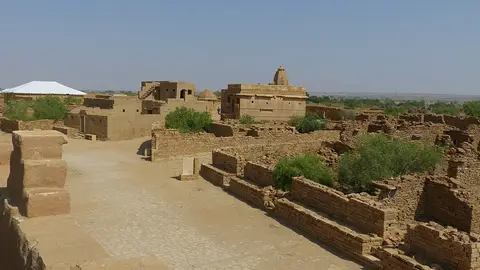
Bhangarh sits at the foot of the Aravalli hills on the edge of the Sariska Tiger Reserve, roughly halfway between Jaipur and Alwar. According to the usual account, the Kachwaha ruler of Amber, Raja Bhagwant Das (also written Bhagwant Singh), founded it in 1573 as a seat for his younger son, Madho Singh – the brother of Man Singh, the great general of the Mughal emperor Akbar. Sources disagree on the date: India’s official tourism site instead says the fort was built in the 17th century by Madho Singh himself, and some references give 1613. Within its walls grew a full fortified town: a bazaar street lined with shops, the so-called dancers’ haveli, a priest’s mansion, a royal palace climbing the hillside, and a cluster of carved stone temples to Gopinath, Someshwar, Keshav Rai, Mangla Devi and Hanuman.
Today almost everything except the temples stands roofless, and the emptiness is what made Bhangarh famous. Two curse legends explain it. In one, an ascetic named Guru Balu Nath allowed the fort to be built on condition that its shadow never touch his hermitage; when a later ruler raised the walls too high, the town was doomed. In the other, a tantrik called Singhia fell for Princess Ratnavati and tried to snare her with an enchanted potion or oil; she threw it onto a boulder, which rolled onto him, and he cursed the town as he died. Guides add that the princess and most of the garrison then perished in a war with neighbouring Ajabgarh, and that the dead can never be reborn and so linger in the ruins.
The documented history is more ordinary. Writing in The Hindu, the historian Rana Safvi notes that after Madho Singh’s grandson Ajab Singh founded his own fort at Ajabgarh, Bhangarh’s population drifted away; Raja Jai Singh of Amber absorbed the estate in 1720, and a famine in 1783 drove out most of those who remained. Abandonment, monsoon rains and centuries of stone-robbing left the roofless shell that visitors see now. A small hilltop structure known locally as the tantrik’s chhatri still overlooks the site.
The ghost reputation is largely a modern one, built up from the late 20th century by travel writers, television and, later, internet lists that crowned Bhangarh “Asia’s most haunted place.” A blue Archaeological Survey of India (ASI) signboard at the gate, which forbids entry before sunrise and after sunset under threat of legal action, became the most photographed proof. The ASI, which protects the monument, posts the same kind of restriction at many remote sites; officials and local historians point to unlit, rocky ground and wildlife from the neighbouring tiger reserve. Rana Safvi reported that the guards on duty told her they had never seen anything unusual.
Bhangarh nonetheless draws large crowds of day-trippers from Jaipur and Delhi, many of them more interested in the dare than the architecture. The temples within the walls are still places of worship, and visitors are expected to treat them as such.
What people report
Visitors and guides speak of a heavy, watchful silence, sudden drops in temperature, unexplained voices, music or anklet bells in the bazaar and palace, a sense of being followed, and shadowy figures among the ruins. Local lore says roofs built in the nearby village collapse, and that anyone who stays inside after dark will not come back. None of these accounts has been documented beyond anecdote.
Where and when
Stories cluster around the royal palace at the top of the site, the Jauhari Bazaar street, the dancers’ haveli and the tantrik’s chhatri on the hill above. The reported activity is said to begin at dusk – which is exactly when the site closes.
Timeline of the haunting
- 1573A fort town for Madho Singh Bhangarh, Rajasthan
Raja Bhagwant Das of Amber establishes Bhangarh for his younger son Madho Singh, according to the commonly cited founding date; other sources place the building of the fort in the early 17th century. The walled town grows to include palaces, havelis, a market street and several temples.
- 1720Absorbed by Amber Bhangarh, Rajasthan
Raja Jai Singh of Amber attaches Bhangarh to his own estate. By then the town had already lost people to the rival fort at Ajabgarh, founded by Madho Singh’s grandson.
- 1783Famine empties the town Bhangarh, Rajasthan
A famine pushes most of the remaining inhabitants to leave. The slow abandonment, rather than a single catastrophe, is what left the site deserted.
- November 2017A historian visits Bhangarh, Rajasthan
Rana Safvi’s column in The Hindu sets the curse legends beside the historical record and reports that the site’s guards denied ever seeing paranormal activity.
What could explain it?
- The town emptied gradually – a rival fort at Ajabgarh, annexation in 1720 and the famine of 1783 – so no curse is needed to explain the ruins.
- The sunset-to-sunrise rule is a standard ASI safety and conservation measure at isolated monuments, made more important here by uneven ground and wildlife from the Sariska Tiger Reserve.
- Roofless stone ruins at dusk, wind through broken arches and the calls of animals and birds are easily heard as voices or footsteps by visitors primed by the legend.
- Much of the “most haunted” reputation comes from television, travel marketing and online rankings that repeat one another rather than from any recorded investigation.
Ghost tours, books and screen
Bhangarh is a fixture of Indian ghost television, travel blogs and YouTube dares, and it tops almost every “most haunted places in India” list. Rajasthan tour operators sell it as a day trip from Jaipur, and the curse stories are told by guides at the gate.
Places to visit
Government of India tourism page with timings and travel advice; the site lies off State Highway 29 between Dausa and Thanagazi.
Watch

Where it’s reported
Bhangarh Fort in the news
No recent headlines about Bhangarh Fort. Our news desk checks every day — see all the latest paranormal news.
Sources
First published · Updated