Case file · Residual haunting · Castle or palace
Shaniwar Wada
Also known as Shaniwarwada, Narayanrao’s ghost
The fortified palace of Pune’s Peshwas, where the boy ruler Narayanrao was murdered in 1773 – and where his cry “Uncle, save me!” is said to echo.
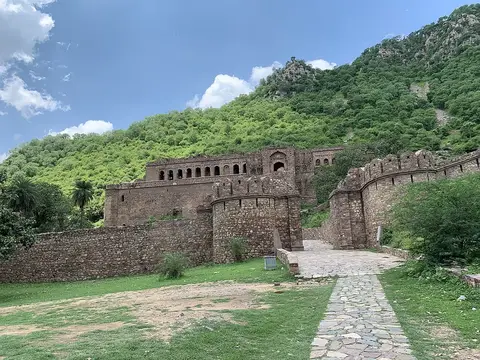
Shaniwar Wada was the seat of the Peshwas, the hereditary chief ministers who ran the Maratha state for most of the 18th century. Peshwa Baji Rao I laid its foundation on a Saturday – shaniwar in Marathi – in January 1730, and the residence was formally opened, again on a Saturday, in January 1732. Later Peshwas added walls, bastions, court halls and fountains. Its massive Delhi Darwaza, studded with iron spikes against war elephants, deliberately faced north towards the Mughal capital.
The palace’s darkest day came during the Ganesh festival of 1773. Narayanrao, an 18-year-old who had become Peshwa the year before after the death of his brother Madhavrao, had kept his ambitious uncle Raghunathrao under guard. On 30 August 1773 a party of guards forced their way into the palace and killed Narayanrao, along with several servants and attendants. Raghunathrao and his wife Anandibai were held responsible. A famous tradition says Anandibai altered a single letter of an order, turning dharave (“seize him”) into marave (“kill him”), though historians treat that detail as legend.
The ghost story grew from that night. According to the popular telling, the teenage Peshwa ran through the palace crying “Kaka, mala vachva!” – “Uncle, save me!” – before he was cut down, and his voice can still be heard on full-moon nights. The palace’s southern Narayan Darwaza is said to take its name from the gate through which his body was carried out for cremation.
The Peshwa state ended in 1818, when Baji Rao II surrendered to the British East India Company. On 27 February 1828 a fire broke out inside the complex and burned for about a week, destroying the timber palace buildings. Only the stone ramparts, the great teak gates and the foundations survived, so most of what visitors walk through today is a walled garden of plinths and fountains. The site is now a protected monument in the heart of old Pune, one of the city’s most visited landmarks and the setting of the 2015 film Bajirao Mastani.
What people report
Local tradition holds that a boy’s voice calls “Kaka, mala vachva!” from inside the walls, especially on full-moon nights, and some neighbours and night workers in the surrounding peths say they have heard cries or screams after dark. Guides also mention a heavy atmosphere near the ruins of the palace interior. The reports are anecdotal.
Where and when
The cry is placed inside the ramparts, around the ruined palace foundations and near the Narayan Darwaza on the south side, and at night when the monument is closed.
Timeline of the haunting
- 10 January 1730Foundation on a Saturday Pune, Maharashtra
Peshwa Baji Rao I lays the ceremonial foundation of his residence, which takes its name from the day of the week. It is completed and opened in January 1732.
- 30 August 1773The murder of Narayanrao Pune, Maharashtra
Guards break into the palace during the Ganesh festival and kill the young Peshwa Narayanrao and members of his household. The cry he is said to have raised becomes the basis of the haunting.
- June 1818The last Peshwa surrenders Maharashtra
Baji Rao II gives up power to the British East India Company and goes into exile at Bithoor, near Kanpur. The palace passes out of Maratha hands.
- 27 February 1828The great fire Pune, Maharashtra
A fire starts inside the complex and rages for about seven days, leaving only the ramparts, gates and foundations. The cause has never been established.
What could explain it?
- The murder of Narayanrao is well documented, but the ghost story is oral tradition; no recorded investigation has captured the cry.
- Shaniwar Wada sits in a dense, noisy part of old Pune, and voices, animals and traffic echo off its high walls at night.
- A story told for two and a half centuries primes listeners to hear the famous words in ordinary sounds – a form of auditory pareidolia.
- Night closure of the monument, which is routine for protected sites, is often misread as proof that it is haunted.
Ghost tours, books and screen
The legend of “Kaka, mala vachva” is known to almost every child in Maharashtra and features in Marathi plays, TV serials, podcasts and Halloween features. The palace itself is a symbol of Maratha history and of Pune, and appears in Sanjay Leela Bhansali’s Bajirao Mastani (2015).
Where it’s reported
Shaniwar Wada in the news
No recent headlines about Shaniwar Wada. Our news desk checks every day — see all the latest paranormal news.
Sources
First published · Updated