Case file · Poltergeist · House or mansion
George Walton and the Stone-Throwing Devil
Also known as Lithobolia, The Devil of Great Island, Great Island stone-throwing, 1682
In 1682 stones rained on the tavern of Quaker George Walton on Great Island, New Hampshire, in one of colonial America’s first poltergeist cases.
Great Island, now the town of New Castle, sits at the mouth of the Piscataqua River, and in the 1680s royal officials of the Province of New Hampshire were among the visitors to its taverns. One of its leading residents was George Walton, a Quaker innkeeper, merchant and lumberman who had become the island’s largest landowner. According to the Mather account quoted by the New England Historical Society, stones began to fall on his house and tavern, and on Walton himself, on 11 June 1682, and the bombardment lasted about three months.
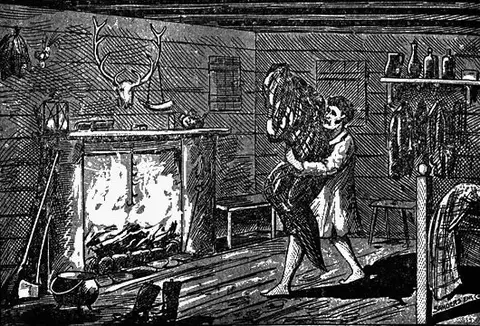
The best contemporary record is a journal-style narrative by Richard Chamberlayne, a secretary to the royal governor who was a guest at the tavern during the events. It was not printed until 1698, in London, as Lithobolia, or the Stone-Throwing Devil, and Increase Mather also covered the case in his Illustrious Providences. Accounts speak of stones of many sizes, some said to weigh about thirty pounds, hitting the house, smashing windows and striking those who came to look. Household objects such as hammers, pots and andirons were said to move on their own, and witnesses described whistling noises and voices. No one ever saw a thrower.
Walton publicly blamed a neighbour, the elderly widow Hannah Jones, with whom he had a long-running dispute over a property boundary. He called her a witch; she is reported to have answered by calling him a wizard. The matter never reached a trial. Historian Emerson Baker’s study of the case, The Devil of Great Island, argues that the affair grew out of local tensions: Walton was a Quaker among Puritans, had recently employed two Native American workers after King Philip’s War, was prosperous, kept a tavern popular with fishermen, and was caught up in political disputes over the new province’s government and a proposed separate parish.
Whatever happened, the story travelled. Copycat stone-throwing incidents were reported later in 1682 in Berwick, Maine, and Hartford, Connecticut, and the Great Island case is often discussed as a precursor of the Salem witch panic a decade later. Neither Walton nor Jones is shown by the sources used here to have been tried or punished.
What people report
Stones falling on a tavern and on its owner from an unseen source; household objects moving; voices and whistling; no visible thrower.
Where and when
George Walton’s house and tavern, his farm and the surrounding ground on Great Island, now New Castle, New Hampshire; the building no longer stands.
Timeline of the haunting
- Summer 1682Accusation against Hannah Jones Great Island, New Hampshire
Walton blamed his neighbour Hannah Jones, a widow, for witchcraft; she answered by calling him a wizard, and no trial followed.
- 11 June 1682The first stones Great Island, New Hampshire
On a moonlit night, stones struck George Walton and companions as they walked home; the bombardment continued over the summer.
- 1698Lithobolia published in London London, England
Richard Chamberlayne’s journal-style narrative was printed sixteen years after the events.
- 2007The Devil of Great Island United States
Historian Emerson W. Baker published a scholarly study placing the case in its social and political setting.
What could explain it?
- A feud with a neighbour: the property dispute with Hannah Jones is the obvious social background, and the case reads partly as an accusation of witchcraft that never became a trial.
- Human agency: a hostile person or group throwing stones from the dark is the simplest ordinary explanation, and Baker’s study discusses the resentments toward Walton that might supply motives.
- Politics and religion: Walton’s Quakerism, his royalist guests and his Native American employees made him a target in a province split over governor, church and land claims.
- Reporting bias: the main narrative was written by a guest of the household and printed years later, so it may reflect Walton’s side of the story.
Ghost tours, books and screen
Lithobolia has been called an early work of American supernatural horror writing. It appears in histories of New England witchcraft, in the New Castle local-history literature and in the 1952 horror comic The Unseen, which retold it as The Devil’s Stones.
Where it’s reported
Sources
First published · Updated